
How to Search Criminal Dockets
Your first stop is Kansas CaseSearch. Accept the agreement, finish the verification step, then pick Norton County from the location filter. A full case number works best. Searching by name? Add a case type or a file-date range only to separate public results from each other. Keep the court level in mind, since city ordinance matters and federal prosecutions sit with other offices entirely.
- Identify the district, municipal, or federal court on the notice.
- Enter the exact case number or a narrow name query.
- Confirm Norton County, type, filing date, and public status.
- Read events in date order and find the newest valid setting.
- Ask the clerk for a specific public document if the index is not enough.
CaseSearch is an index and a route to documents, not a promise that every filing image is online. When nothing matches, check the court, the county, the old or new number format, and the restriction category first. Only then consider that no record exists.
Norton Criminal Case Number Seam
Norton County moved onto the Odyssey electronic system on July 11, 2022. That switch is why older and newer case numbers look so different. A neutral modern sample is NT-2024-CR-000001. A neutral older one is 2021-CR-000001. Neither points to a real case. Copy case-type letters, punctuation, and leading zeros exactly.
In the newer format, NT stands for Norton, CR marks the criminal case type, and the sequence is the consecutive number the court assigns.
A pre-2022 number does not mean a failed modern docket search. Try it exactly as printed. If a converted record stays off the web, narrow the location to Norton and ask the clerk or use the public terminal.
What a Criminal Docket Shows
Kansas Supreme Court Rule 106B names the basic public chronology a register of action. Norton County describes it as filed papers, process requests and returns, appearances, orders, verdicts, judgments, and payments arranged by date. One caution: a public result may summarize an event without showing its document image.
| Case number | Court, year, type, and sequence, such as NT-2024-CR-000001. |
|---|---|
| Charge | The filed allegation and classification, not a judgment of guilt. |
| Appearances | Arraignment, counsel, bond, pretrial, motion, or trial activity. |
| Settings | Date, time, judicial officer, place, and setting type when public. |
| Disposition | The result stated by the register or operative court order. |
Say "dismissed," "acquitted," or "convicted" only when the court record uses that word. A charge category or case status filter decides nothing about what happened.
Norton Criminal Dockets Are Chronologies
A filing and an outcome are different points on a Norton County criminal docket. Read down the event dates instead of lifting one phrase from a caption. "Filed" means the court received an item. "Continued" or "reset" just changes a setting. When entries conflict, the newest valid order controls. It beats an older calendar line.
Docket flow: Filing › Arraignment › Pretrial › Plea or Trial › Disposition › Sentencing
The path may include motions, bond events, counsel appearances, or later appeal activity. Annual-report felony and misdemeanor columns are aggregate categories, not conclusions about any named person. Disposition counts for a reporting period do not equal current pending cases, either, because matters can cross fiscal years.
Stages on a Criminal Docket
A Norton County case often opens with a complaint, information, or another initiating entry. Process, first appearance, arraignment, counsel, and bond activity can follow. Pretrial settings and motions come before a plea or trial in many records. Judgment, disposition, sentence, payments, and appeal entries may come later.
Remember what a line does not prove. A scheduled event does not confirm the hearing occurred. A motion records a request, not the judge's ruling. A plea is distinct from a sentence. When a reset appears, find the replacement setting. Confirm it with the filed notice, counsel, or clerk. These distinctions keep a docket useful without overstating a single line.
Norton Court Services Has Another Role
The county's Court Services office runs adult probation, bond supervision, reports, and presentence investigations. That work can generate docket events. Even so, Court Services is not the copy desk; the Clerk of the District Court remains the Norton County criminal docket custodian. The official county page shows how the duties divide.
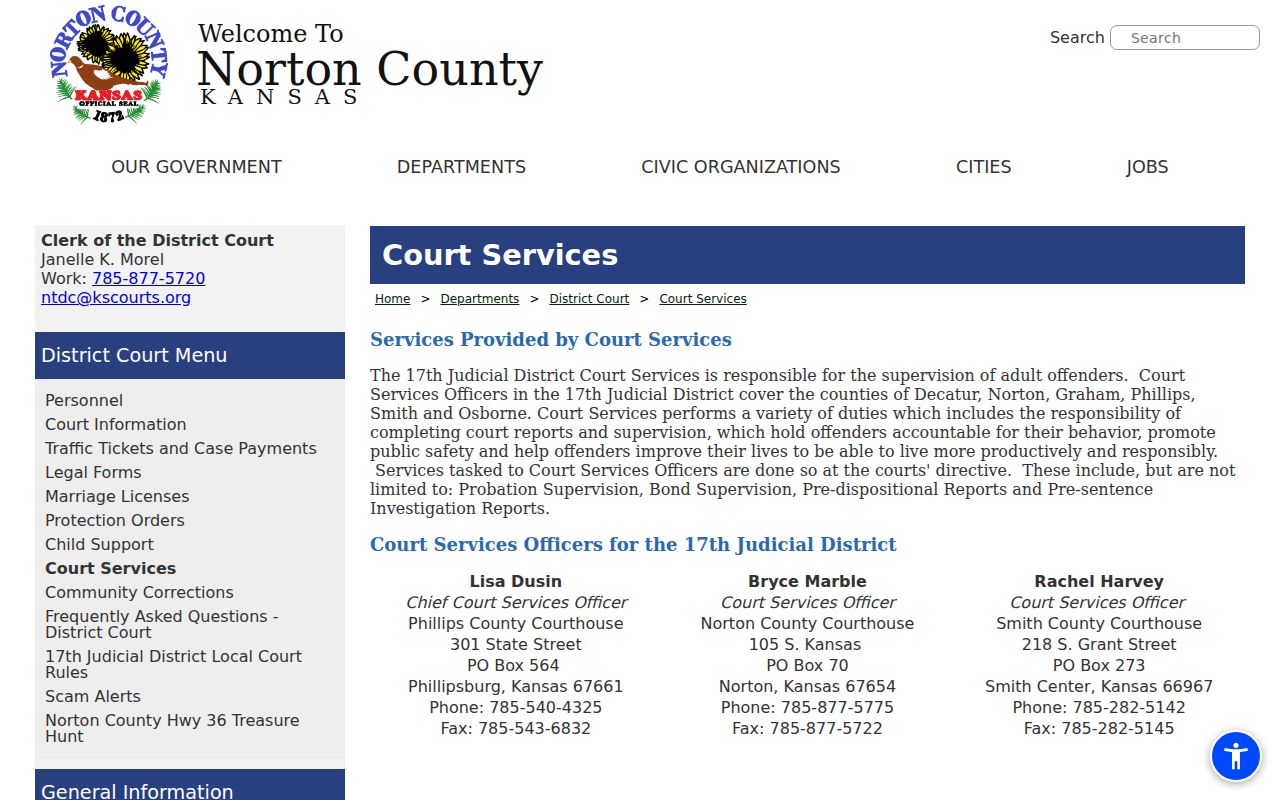
Need a filed judgment? Ask the clerk for that item. Someone under active supervision should contact the office named in the order. Appointed counsel works the same way: the county FAQ describes the application and financial information required, and a docket lookup does not replace that process.
Which Court Holds Criminal Dockets
Norton County District Court holds the state criminal records described by the county clerk. It is part of the six-county 17th Judicial District. District Judge Jessie Thompson and District Magistrate Judge Jody Enfield are listed for Norton. Paula Hofaker serves as chief judge. Judicial work can span the district. So a judge's name alone does not prove a Norton filing.
Norton Municipal Court at City Hall keeps qualifying City of Norton ordinance matters separately. Federal prosecutions belong to the U.S. District Court for the District of Kansas. Those run through PACER. Before reading the events, confirm the court and county in the case header. The Norton courthouse terminal is not a municipal or federal archive.
Norton Has No Public Warrant List
The district-court FAQ says staff will not discuss warrants and routes those questions to the Sheriff or County Attorney. That boundary does not justify an unofficial name list. It points to a verified government contact and careful handling of unexpected payment demands.
Verify unexpected demands. The official court scam warning says callers will not demand gift cards or cryptocurrency.
Do not give bank, card, Social Security, or birth-date information to an unsolicited caller.
The county’s warning shows the approved safety route.
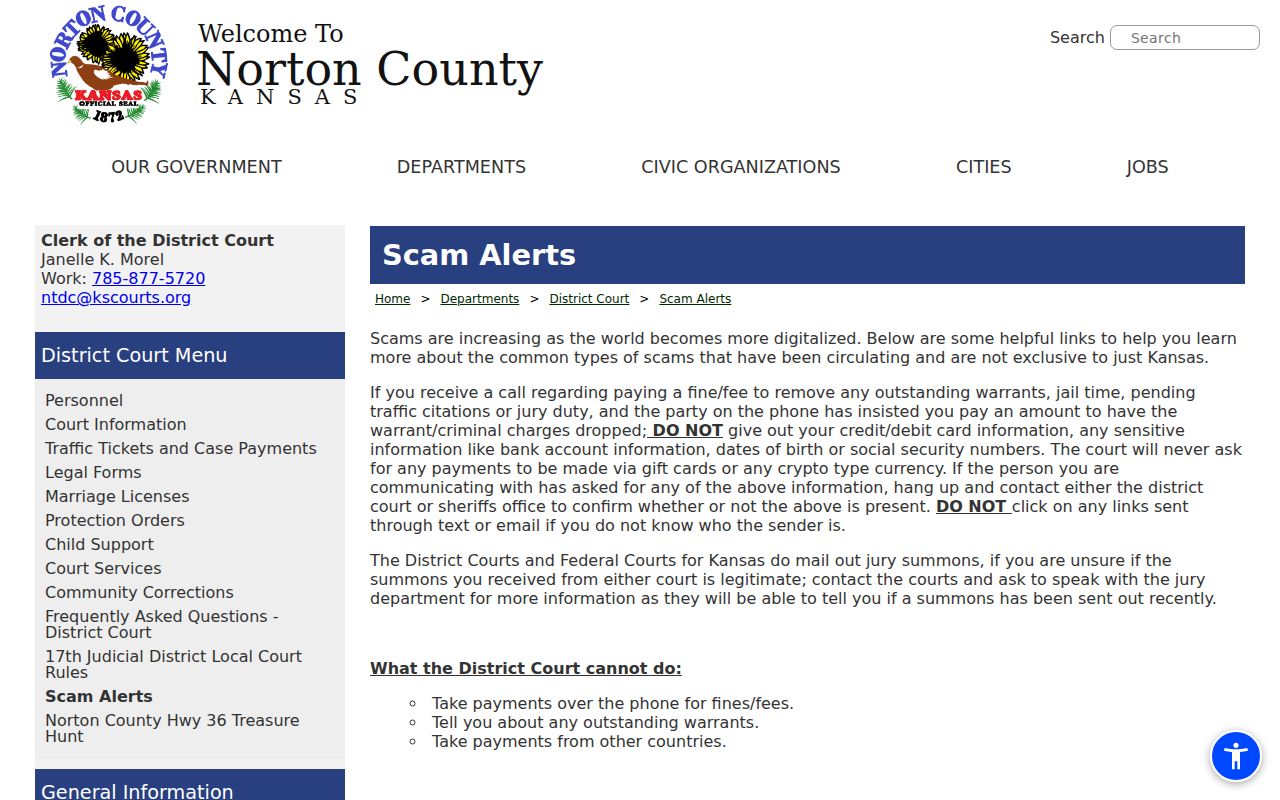
Call a published office number yourself rather than one supplied by the caller.
Norton Criminal Docket Access Chain
CaseSearch leaves gaps sometimes. When it does, try the free Public Access Terminal. It sits on the third floor of the clerk's office at 105 South Kansas Avenue, Norton. You can also call 785-877-5720 during weekday hours of 8:00 a.m. to noon and 1:00 to 5:00 p.m. Requests can also travel by mail to P.O. Box 70, Norton, KS 67654, by fax to 785-877-5722, or by email at ntdc@kscourts.gov, and in person works too.
Whatever route you pick, give the clerk the case number, the exact item you need, the date range, your delivery choice, and whether you need certification. Norton County promises a response within three business days. That reply may simply be a question or a cost estimate, though. One more caution applies here. Ordinary court filings sent by email are not accepted. A communication address is never an authorized filing channel.
Public Access and Sealed Criminal Dockets
Public access has limits, even for a Norton County criminal docket. Rule 22 governs what courts can share electronically. Rule 106B sets out the register of actions and the courthouse-terminal framework. Some material sits behind separate limits entirely. Juvenile cases, search warrants, grand juries, inquests, expunged items, and anything closed by law or by order all sit there.
That is why an ordinary public docket search can come up short. The official Kansas criminal expungement statute spells out how a record can be removed from view. Certain conditions must be met first.
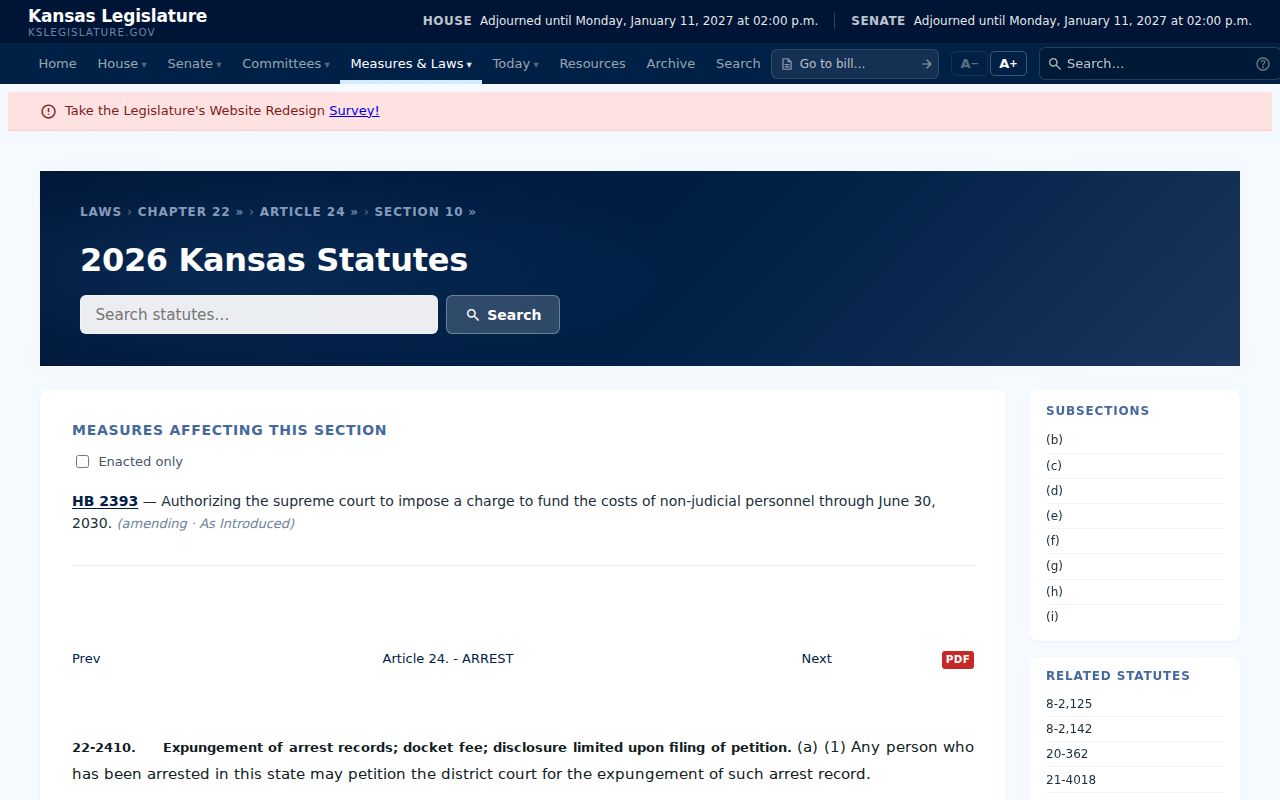
Absence from the portal therefore is not proof that no proceeding occurred.
Access rule: Use the clerk’s lawful request process for a missing public item, and do not use sensitive identifiers to defeat a restriction.
Only the record custodian can issue a certified copy.
Finish any Norton County docket check the same way. Compare the newest setting, disposition, and judge entry against the official case number. Aggregate filing totals tell you nothing about a single criminal matter. That case may be pending, closed, diverted, or awaiting sentence. If the web chronology and a paper notice disagree, the Clerk can confirm what the public record says. Only the court itself can change a setting or an order.